The following texts were partially or completely generated with the help of generative AI models.
Lately, there has been a lot of talk about digital sovereignty and about how we should be more careful when storing our data on the platforms of large American providers. There has been a concept called the "Asset Administration Shell" for quite some time now, but hardly anyone knows about it. We want to change that with this blog post.
What is an Asset Administration Shell?
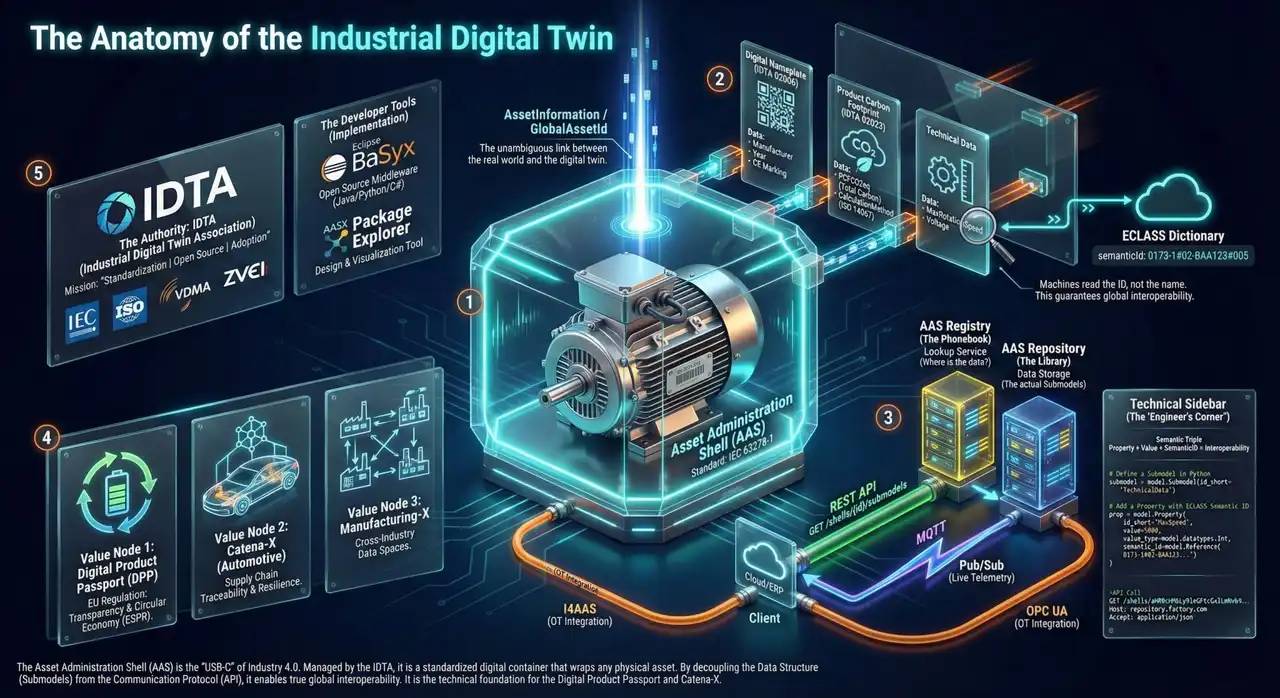
In short: The Asset Administration Shell (AAS) helps companies store business data in a structured, standardized, and vendor-independent way – and that is exactly what strengthens digital sovereignty. It creates a uniform data model for every asset and makes it possible to keep data controllable, interoperable, and usable in the long term.
How the Asset Administration Shell Strengthens Digital Sovereignty
1. A Uniform, Vendor-Independent Data Structure
The Asset Administration Shell is an industry-neutral standard that provides information in a uniform language.
This means:
- Data remains understandable, even when systems or vendors change.
- Companies retain full control, because they are not tied to proprietary formats.
- Long-term usability is ensured – a key building block of digital sovereignty.
2. A Clear Separation of Asset and Data
Every physical or digital asset gets its own Asset Administration Shell.
This enables:
- Clean, modularized data storage
- Transparent assignment of information, metadata, states, and versions
- Less chaos in databases and ERP systems
For us as SAP consultants, this is especially exciting: The AAS can serve as a semantic bridge between OT and IT – without proprietary dependencies.
3. Interoperability as a Sovereignty Factor
According to the German Federal Ministry, digital sovereignty means being able to control data and systems independently and securely, without being dependent on individual technology providers.
The Asset Administration Shell supports this by:
- providing standardized interfaces
- facilitating the exchange between machines, systems, and partners
- enabling ecosystems in which every participant retains their data sovereignty
4. A Foundation for Digital Twins and Product Passports
The Asset Administration Shell is the backbone of the digital twin.
This makes it the central storage location for:
- technical data
- usage data
- lifecycle information
- sustainability and compliance data
Especially in the context of the Digital Product Passport, the AAS becomes a sovereign data store, because it:
- uses standardized data models
- can represent regulatory requirements
- ensures data portability
5. Data Sovereignty Through Decentralized Storage
Digital sovereignty also means:
Storing data where you have control yourself – not in proprietary clouds without an exit strategy.
The Asset Administration Shell supports:
- decentralized architectures
- federated data spaces
- Gaia-X-compliant data storage
This allows companies to manage data self-determinedly, without relying on central platforms.
Asset Administration Shells and Digital Twins for SAP ABAP
Since January 2026, we have had a new training course, "ABAP HTTP Connectivity - Fundamentals", in our program, which deals with data and system integration via HTTP services in ABAP. Our hands-on example is the Asset Administration Shell and the digital product passport.
As part of the training, we show how to integrate systems such as the Asset Administration Shell using modern ABAP in a Clean Core. This knowledge of course also helps with the integration of other solutions via HTTP services.
You can find more information in our training catalog.