The following texts were partially or completely generated with the help of generative AI models.
SAP's Clean Core Level concept has now been around for about a year. It replaces the old 3-tier model and no longer rates existing Z-code in binary terms as "clean" or "not clean," but on four levels from A to D. At the very bottom is Level D: things SAP actively advises against — using "noAPI" objects, modifications, implicit enhancements, direct table access. In other words, exactly what tends to pile up generously in a codebase that has grown over twenty years.
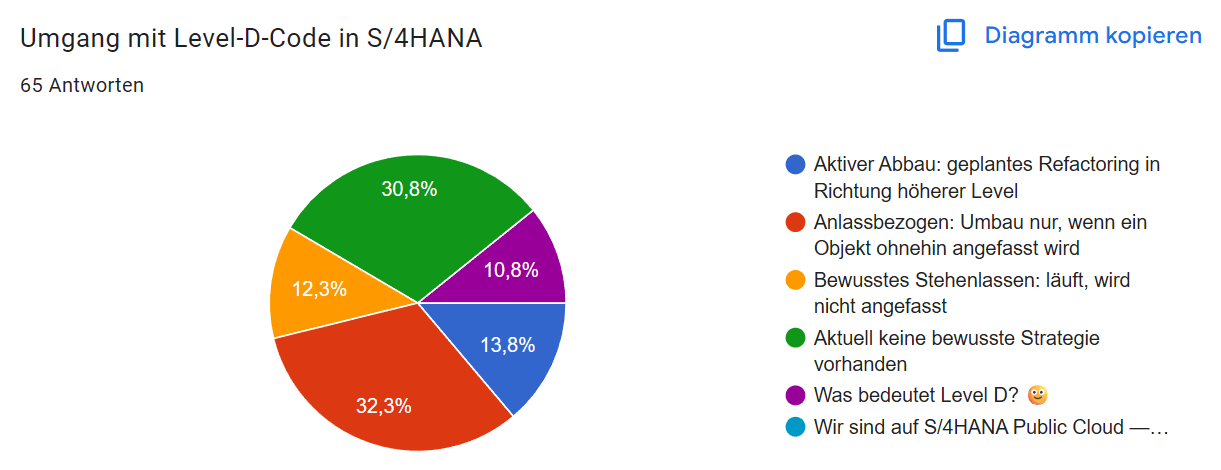
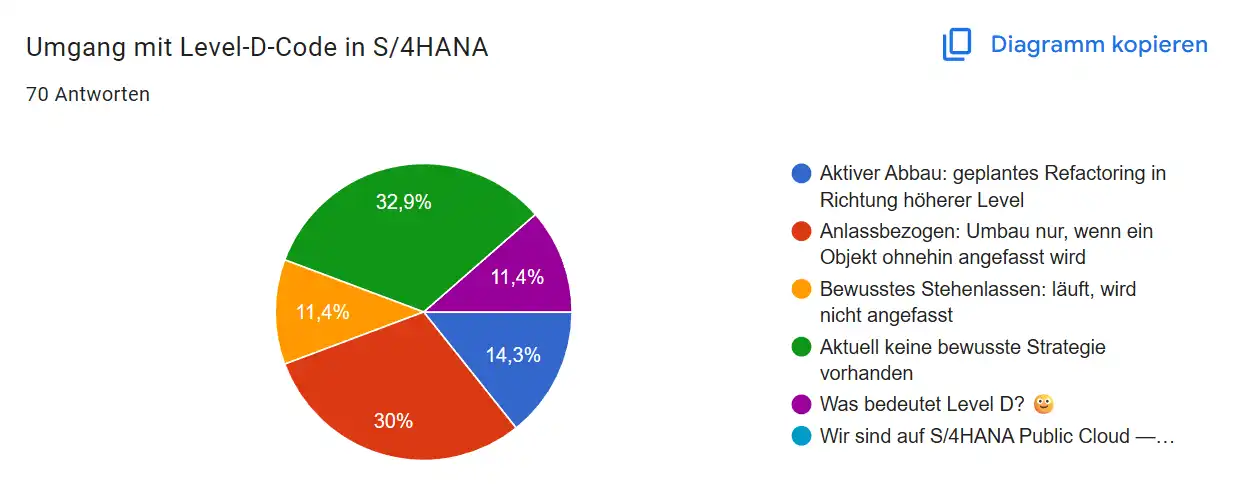
During a training session recently, a customer asked me: "So how do other companies handle this?" Good question. So I ran a poll in the DSAG forum — deliberately limited to SAP customer companies, not consulting firms. 65 responses have come in so far. The results are interesting.
The numbers
How does your company handle Level D code?
Updated 7/30/2026, 9:00 AM with the current poll standing.
| Answer | Votes | Share |
|---|---|---|
| Active reduction: planned refactoring toward higher levels | 9 | 14.3% |
| As-needed: only refactored when an object is touched anyway | 21 | 30.0% |
| Deliberately left as-is: it works, don't touch it | 8 | 11.4% |
| No deliberate strategy in place | 20 | 32.9% |
| What does Level D mean? 🙂 | 7 | 11.4% |
| We're on S/4HANA Public Cloud — we don't have Level D | 0 | 0% |
Five observations
1. Only one in seven is actively cleaning up
14.1% run planned refactoring toward higher levels. This is the group that treats Level D as technical debt and has the time and budget to tackle it. Everyone else either has good reasons to wait — or no reason at all, because they never asked the question.
2. "As-needed" is the quiet winner
At 30%, this pragmatic middle path is the most common deliberate strategy: if an object is being touched anyway, it gets bumped up to a higher level while you're at it. That's Robert C. Martin's Boy Scout Rule from his book Clean Code. Together with the active cleanup group, about 46% see a fundamental need to act. At least in the very long run, the debt does get paid down.
The majority — 54% — isn't addressing the issue at all.
3. At least 41% are flying blind
Here's where it gets interesting: 32.9% have no deliberate strategy, and another 11.4% aren't even familiar with the Level concept. Together that's over 44% who meet their Level D code with neither a plan nor a decision. That said, the practical difference from "deliberately leaving it as-is" isn't all that large by the time the next upgrade comes around.
4. One in ten has never even heard of it
A year after the Level concept was introduced, 11.4% of respondents don't know what Level D means. And this in the DSAG forum, of all places. It's fair to assume the number looks considerably worse outside the circle of active DSAG forum visitors. SAP's communication on this clearly still has room for improvement.
5. Public Cloud: zero
Not a single response came from Public Cloud customers. Granted: the poll ran in an environment dominated by classic on-premise systems, and anyone without a Z code base probably wouldn't have clicked on the poll in the first place. But the zero is still a data point. The world where Level D doesn't exist by definition simply isn't visible within DSAG yet.
Putting it in perspective
The generous reading: nearly half of all companies have a deliberate position on Level D — ranging from active reduction to calculated inaction.
The other reading: over 50% aren't tackling the issue at all. And these are exactly the companies it will hit hardest later on — during release upgrades, when moving to ABAP Cloud, or when that modification from 2009 suddenly blocks a project. And Level D code is only the tip of the iceberg. Level C is questionable too.
For companies whose S/4HANA migration went entirely according to plan and involved little effort, there's no real need to act — in that case, having no strategy at all is perfectly fine, too. For everyone else, the only real recommendation is to get to grips with the concept and at least tackle the tip of the Level iceberg.